Knowledge questions provide the pillar of the TOK curriculum. They are crucial in the creation of significant and well made TOK discourses as they allow students to focus on knowledge itself and how people know. This allows students to go beyond specific subjects or real-life and into the area of TOK.
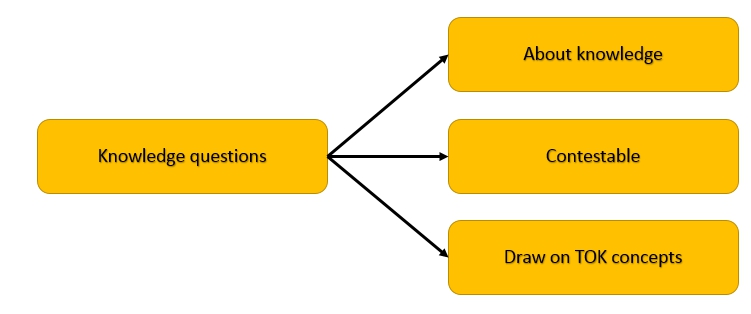
Knowledge questions, as the name suggests, are about knowledge: how it is produced, shared, used and acquired, what is not and what is knowledge; those who might be able to access it and who cannot and who are able to provide answers for these questions. In place of specific subjects, students must examine the construction and evaluation of knowledge itself. This is what makes the subject unique but also challenging.
Now, just because students raise questions does not mean that they have to find an answer. In fact, knowledge questions, by principle, must be contestable: meaning, there should not be a simple solution, they need to be open.
To examine these questions, TOK draws on its own concepts and terminology, rather than borrowing those from the other subjects they study or real-life examples. These questions are often taken for granted yet at the same time are the reason behind disagreements and problems seen throughout the world. Their exploration allows students to better understand how knowledge is created and viewed from different perspectives and practices.
Along with knowledge questions, students must know how to use and understand the following 12 concepts. They are evidence, certainty, truth, interpretation, power, justification, explanation, objectivity, perspective, culture, values and responsibility. Evaluating these concepts in correlation with knowledge questions allows students to grow their understanding of TOK.
Analyzing the May 2025 TOK Essay Questions
The Theory of Knowledge (TOK) essay is an essential part of the IBDP program that all students face. Thus, the ability to comprehend and explore the 6 essay questions you will be facing is a must. Understanding each question's key terms and underlying assumptions is essential to crafting a compelling argument. Below are some sharings on this year’s TOK essay questions -
Question 1: Do historians and human scientists have an ethical obligation to follow the directive: “do not ignore contradictory evidence”?
This question focuses on the ethical implications in the AOKs of history and human sciences. The concept of evidence here is critical, as it asks how historians and human scientists interact with opposing information. Ethical considerations in knowledge production and dissemination should be examined accordingly. Students can draw on examples from their history or human sciences studies to explore whether professionals in these fields must acknowledge all evidence, even when it challenges prevailing narratives or hypotheses.
Question 2: Is our most revered knowledge more fragile than we assume it to be?
This question delves into the meaning and justification of "most revered knowledge" across different AOKs. While it may seem straightforward, the notion of "reverence" is subjective and requires careful unpacking, as does fragility. In the arts, for example, students should focus on knowledge generated by the arts rather than just individual works.
Question 3: How can we reconcile the relentless drive to pursue knowledge with the finite resources we have available?
This is a "how" question that pushes students to explore solutions to an inherent tension between knowledge pursuit and limited resources. Defining "reconcile" is crucial to providing a coherent argument, especially when tackling the assumption that resources—whether intellectual or physical—are finite.
Question 4: Do the ever-improving tools of an area of knowledge always result in improved knowledge?
The question hinges on the relationship between tools and the improvement of knowledge. The challenge is to define what counts as "improved knowledge" and whether tools are simply making knowledge more detailed or enabling entirely new forms of understanding. This question also touches on technological advancements and could be explored through both the natural sciences and mathematics, but it’s important to not restrict the discussion to only modern tools.
Question 5: To what extent do you agree with the claim “all models are wrong, but some are useful” (attributed to George Box)?
This question asks students to consider the reliability and limitations of models, particularly in mathematics. The nature of axioms and abstract structures in mathematics makes this AOK especially relevant. To fully explore the question, students should consider not just when models fail but also how they contribute to knowledge even when they’re flawed.
Question 6: Does acquiring knowledge destroy our sense of wonder?
This is an open-ended question. Defining "a sense of wonder" is key, as is considering how this concept fits into real-world examples. Does knowledge deepen curiosity, or does it restrict the space for wonder? The essay could draw on AOKs like the natural sciences, where new discoveries often open more questions than answers.
An Overview of the May 2026 TOK Essay Questions
The six prescribed Theory of Knowledge (TOK) essay questions for the May 2026 examination session ask students to engage critically with central ideas about the production, communication, and reliability of knowledge. This article offers a brief overview of each question, highlighting key terms, underlying assumptions, and possible directions of exploration.
1. In the production of knowledge, does it matter that observation is an essential but flawed tool?
Areas of Knowledge: Natural Sciences and one other AOK
This question discusses the role of empiricism in knowledge production, particularly within the natural sciences. While observation is central to scientific inquiry, the question presses students to evaluate the significance of its limitations. To what extent do the flaws in observation undermine its value, and does its indispensability outweigh its weaknesses?
Other Areas of Knowledge (AOKs) such as the human sciences or history provide interesting avenues to further explore the question. In the human sciences, observation is constrained by the complexity of human thought and behaviour, which may not align with external appearances, and, as a result, findings. In history, present-day interpretations of past observations may be incomplete or distorted. Students are encouraged to weigh whether these flaws fundamentally compromise knowledge production, or whether observation remains indispensable despite its imperfections.
2. To what extent do you agree that doubt is central to the pursuit of knowledge?
Areas of Knowledge: Two AOKs of choice
This “to what extent” question invites a spectrum of responses, ranging from minimal to complete agreement. At its core lies the concept of doubt as a driver of inquiry. Skepticism often serves as the catalyst for challenging accepted truths and extending knowledge.
In the natural sciences, for instance, prevailing theories once thought unassailable have been overturned by critical questioning. Even mathematics, founded on axioms and rigorous proof, can be disrupted by counterexamples or shifts in foundational assumptions. At the same time, excessive skepticism risks paralyzing knowledge production. If everything is doubted, certainty becomes unattainable. An effective response should balance the necessity of doubt with recognition of its potential limitations.
3. Is the power of knowledge determined by the way in which the knowledge is conveyed?
Areas of Knowledge: Mathematics and one other AOK
This question revolves around the relationship between communication and knowledge. Mathematics is an interesting starting point, as its knowledge can be conveyed with relative clarity through equations or visual representations such as graphs. In contrast, the arts often rely heavily on the medium and mode of expression: the same idea may be perceived differently depending on how it is conveyed.
The contrast between mathematics and the arts highlights the potential variability in how knowledge attains “power.” For example, a painting such as René Magritte’s The Treachery of Images (1929) demonstrates that the meaning of knowledge within art is inseparable from its mode of conveyance. Students should consider whether the power of knowledge lies primarily in the knowledge itself, in the manner of its communication, or in a combination of both.
4. In the acquisition of knowledge, can we only understand something to the extent that we understand its context?
Areas of Knowledge: Two AOKs of choice
The emphasis on “we” in this question makes it particularly relevant to students as active knowers. It invites reflection on whether knowledge can be comprehended in isolation, or whether context is indispensable to understanding.
Certain AOKs, such as history and the arts, often appear to demand contextual knowledge for proper understanding. A historical event or a work of art may lose significance if divorced from its cultural or temporal background. Conversely, mathematics and the natural sciences are often assumed to function independently of context, drawing strength from their universality. However, this distinction may be too simplistic. Even in mathematics and science, context shapes both the framing of questions and the interpretation of findings.
5. To what extent do you agree with the claim that “all things are numbers” (Pythagoras)?
Areas of Knowledge: The Arts and the Human Sciences
The inclusion of the arts and human sciences in this question is striking, given Pythagoras’s reputation as a mathematician. His claim, however, invites reflection on reductionism: can all aspects of human life and creativity be reduced to numerical representation?
In the arts, one might question whether the value of an artwork can be captured by measurable qualities such as proportion, symmetry, or popularity. In the human sciences, statistical methods provide powerful insights into human behaviour, yet they cannot fully capture individual consciousness or cultural meaning. The question challenges students to consider the balance between quantifiable data and the qualitative richness of human experience.
6. To what extent is interpretation a reliable tool in the production of knowledge?
Areas of Knowledge: History and one other AOK
Interpretation is both indispensable and problematic in knowledge production. In history, it is central: historians interpret evidence, but their accounts are inevitably shaped by perspective, bias, and available sources. The question thus raises the tension between subjectivity and objectivity.
When paired with another AOK—perhaps the natural sciences, mathematics, or the arts—the role of interpretation can be contrasted. While interpretation may seem less prominent in disciplines with rigorous methodologies, closer examination reveals its pervasive influence. Across AOKs, the reliability of interpretation depends not on eliminating subjectivity, but on recognizing and critically evaluating it.
Conclusion
The May 2026 TOK essay questions collectively emphasize the central TOK themes of reliability, communication, context, and perspective. While each question is anchored in specific AOKs, they all encourage students to grapple with assumptions about how knowledge is produced, conveyed, and understood.
A strong essay will not only address the prescribed question directly but also demonstrate critical engagement with different perspectives, counterarguments, and examples from multiple Areas of Knowledge. By doing so, students will showcase the reflective and analytical skills at the heart of the TOK course.